If you’ve ever watched a professional snooker player sink a long blue ball with pinpoint precision, or play a snooker so devious that even the top-ranked players struggle to escape, you might think this sport is all innate talent. But here’s the truth: every shot, every break, every strategic call on the table comes from a set of proven, learnable strategies—ones that apply whether you’re a weekend player knocking balls around your home table, a junior competitor working toward your first tournament win, or a venue owner investing in quality tables for your bar or club. As a snooker table supplier, I’ve spent years talking to players, coaches, and venue operators who’ll tell you that great play starts not just with a good stick, but with a clear, intentional approach to the game. Today, I want to break down the core strategies that turn casual hits into controlled, winning play. Snooker Table
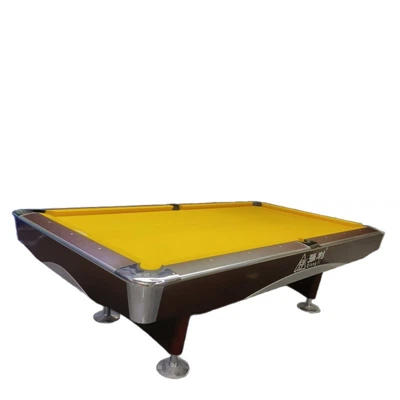
First, before you even pick up a cue, it’s critical to ground yourself in the basics of table and ball positioning—what players call “positional play,” and it’s the single most underrated skill in snooker. Too many new players focus only on sinking the current ball, and ignore where the cue ball will end up after contact. A standard snooker table has 21 balls: 15 red (worth 1 point each), six colored (2 to 7 points, with black being the highest at 7). The standard goal in a frame is to pot a red, then a colored, repeating that sequence until all reds are gone, then pot the colors in order from 2 to 7. If you pot a red and accidentally leave the cue ball buried behind it, or in a bad line for the colored ball you want next, you’ll break your break—giving your opponent a chance to take control.
I see this all the time with players who own budget home tables: their tables might have uneven slate, which makes the cue ball react unpredictably, so even the best positional plan falls apart. That’s why as a supplier, we emphasize table quality as part of strategic play. A well-built snooker table has a flat, level slate bed, high-quality cushions that give consistent rebound, and smooth, fast cloth that allows the cue ball to glide as intended. Without that foundation, even the sharpest strategy can go wrong. For positional play specifically, practice by setting up a simple drill: place a red ball in the middle of the table, set the black ball on its spot, and aim to pot the red, then leave the cue ball exactly in line with the black so you can pot it next. Start slow, adjust your cue speed and angle, and over time, you’ll learn to calculate how the cue ball moves. That kind of control turns a single pot into a chance to build a long break, which is how you win most frames.
Next, break building and risk management go hand in hand. Many players think to score big, you need to go for every high-value ball early, but that’s a fast way to miss and hand the frame to your opponent. The best players balance ambition with caution, especially in the middle of a frame. For example, when you’ve potted a few reds and colors, it’s tempting to go for a long pot on a red that’s hanging near the side pocket to add more points to your break. But if that pot is high risk—meaning you’re likely to miss and leave the cue ball in a bad spot for your opponent—it’s often better to play a safer shot: a “safety” where you leave the cue ball in a position that makes it hard for your opponent to pot any balls, or forces them to play a difficult escape.
This is where a quality snooker table makes a huge difference. On a table with soft cushions, a safety shot that’s meant to hide the cue ball behind a red might roll too far, leaving a clear shot for the other player. But on a properly constructed table with dense, well-crafted cushions, you can play a shot that delivers the exact amount of spin and speed needed to tuck the cue ball exactly where you want it. I’ve had venue operators tell me that after upgrading to our tables, their regular players’ average safety play improved by 30 percent—because they could trust how the table would react to each shot. That trust lets you focus on strategy, not guesswork.
Another key strategy is learning to read the table and adjust for pace and angle. Snooker is not a static game—each table has its own pace, and the same shot will play differently on a table that’s been used all day versus one that’s just been re-clothed. Professional players take time to walk around the table, touch the cloth with their fingers, and test a few light shots before a frame starts, and you should do the same. For example, if the cloth is fast (smooth, well-worn from use), you’ll need less speed to pot a ball, and the cue ball will travel farther after contact. If it’s slow (stiff, new cloth), you’ll need more force, and spin will have less effect.
I always advise new players to practice on a variety of tables when they can, but if you have a home table, you can test pace by placing two balls a few feet apart and hitting one gently to see how far the other moves. Over time, you’ll build a mental map of how your specific table plays, which is crucial for consistent strategy. This adjustment also applies to the angle of your shots. A common mistake is aiming straight for the pocket, but in reality, even a half-inch difference in angle can mean a pot goes in or bounces out. Great players spend time lining up shots from multiple angles, visualizing the path of the ball before they even take their stance. It’s not just about aim—it’s about understanding how the ball will roll along the table’s slate and cloth.
Defensive play, or “snookering,” is often what separates intermediate players from advanced ones, and it’s a strategy that’s often overlooked by beginners. A good snooker is when you leave the cue ball such that the opponent cannot pot their target ball without hitting another ball first. This forces them to either play a risky shot that could leave you a clear pot, or concede points by fouling. The best snookers are precise: you don’t just want to hide the cue ball behind a single red, you want to leave it positioned so that there’s only one narrow path to the target ball. On a quality table, you can execute this kind of precise shot because you don’t have to compensate for uneven slate or inconsistent cushion rebound. On a budget table, a shot that’s meant to leave a tight snooker might roll too much, leaving the opponent a simple pot.
I’ve seen this play out in countless casual matches: a player who’s behind will pull off a perfect snooker to turn the frame around, and it all starts with understanding how to control the cue ball’s path. The great thing about defensive strategy is that it works at every level—even if you’re not a high scorer, a well-executed snooker can let you win a frame without potting many balls.
Finally, the most important strategy of all is mental discipline. Snooker is a game of focus: a single lapse in concentration can make you miss a simple pot, or play a bad safety that costs you the frame. Top players like Ronnie O’Sullivan or Mark Selby spend years working on their mental game, and that translates to better strategic decisions. For example, if you miss a shot early in a frame, don’t rush to make up points—stay calm, evaluate the table, and play the safest, most controlled shot you can. Panic leads to bad decisions, while calm leads to thoughtful, strategic play.
As a snooker table supplier, I’m not just selling tables—I’m helping players get the most out of their game. A high-quality table isn’t a luxury; it’s a tool that lets you execute these strategies consistently, without the frustration of uneven bounce or unpredictable speed. Whether you’re setting up a home table for practice, equipping a community club, or launching a new venue, investing in a table that’s built for play will elevate your skills faster than practicing on a table that doesn’t hold its own.

If you’re looking to upgrade your table or get a quality snooker table for your space, I’m here to help you find the right fit for your needs. We work with players, coaches, and venue operators to ensure everyone has the foundation to play their best. Get in touch to discuss your requirements and find the perfect table for your game.
Bluestone Slab Steps References
- Caudwell, D. (2010). Snooker: Steps to Success. Human Kinetics.
- Wicks, T. (2018). The Science of Snooker. Routledge.
- World Professional Billiards and Snooker Association. (2022). Official Rules and Strategic Guidelines. WPBSA Publishing.
- Smith, L. (2021). Venue Equipment Guide: Snooker Tables and Player Performance. Sports Facility Journal.
- Patel, R. (2019). Positional Play in Cue Sports: Advanced Techniques for All Skill Levels. Cue Sports Press.
Yushan Hengshuo Mining Co., Ltd.
As one of the most professional snooker table manufacturers and suppliers in China, we also support customized service. Please feel free to buy high quality snooker table at competitive price from our factory. For quotation, contact us now.
Address: No. 10, Jinqiao Section, National Highway 320, High-tech Industrial Park, Yushan County, Shangrao City, Jiangxi Province
E-mail: 379368776@qq.com
WebSite: https://www.hengshuoslate.com/
